



BOBST and Michelman have outlined the latest developments in their long-standing collaboration to develop recyclable high-barrier packaging solutions designed to support compliance with the European Union’s Packaging and Packaging Waste Regulation (PPWR).
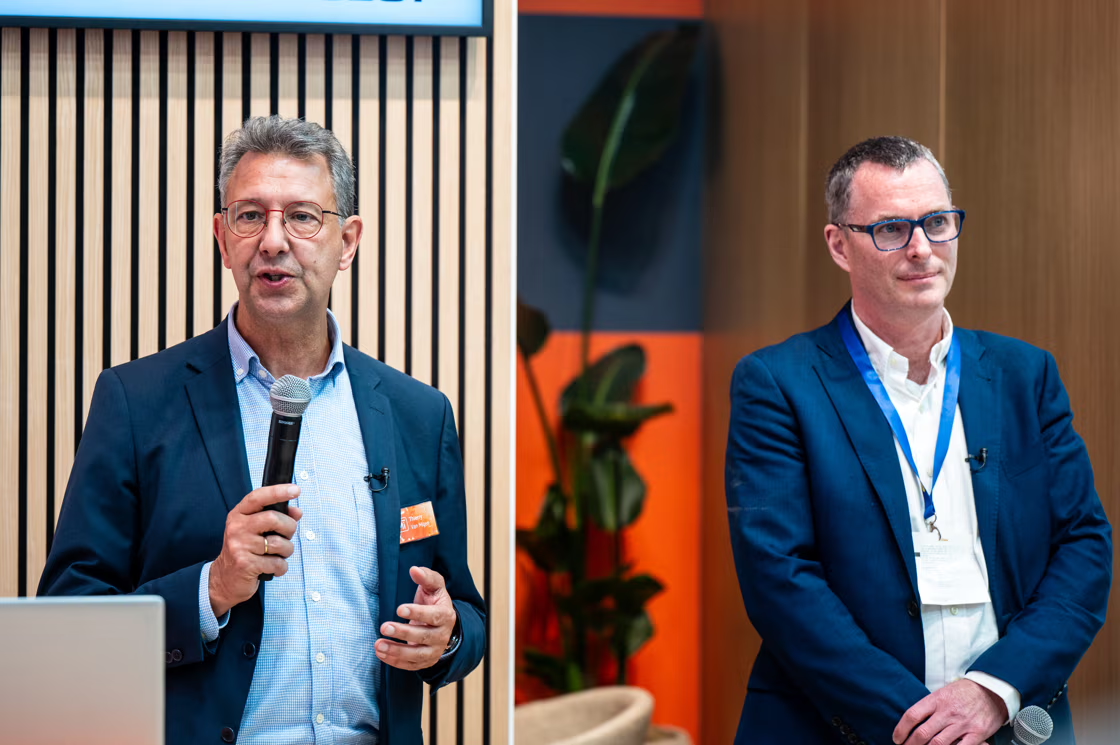
Speaking at interpack 2026 in Düsseldorf, Thierry Van Migem, Director of Sales for the European region at Michelman, and Nick Copeland, R&D Director – Barrier Solutions at BOBST, discussed technologies aimed at replacing conventional multilayer plastic packaging with recyclable alternatives.
The PPWR introduces stricter requirements relating to recyclability, recycled content, reuse and waste reduction. From 1 January 2030, all packaging placed on the EU market must meet minimum recyclability thresholds, initially equivalent to Grade C, or approximately 70% recyclability.
BOBST and Michelman have collaborated for more than a decade, initially focusing on protective coatings for transparent barrier technologies such as AlOx and SiOx. The partnership has since expanded to include mono-material flexible packaging and paper-based structures intended to combine barrier performance with recyclability.
“We needed to get the same barrier performance on much more challenging, less performing substrates,” said Copeland. “That performance had to be achieved but also maintained through each conversion step.”
One of the developments presented was oneBARRIER PrimeCycle, a recyclable mono-material polyethylene structure developed by BOBST, Michelman and other industry partners. The solution combines MDO-PE film, Michelman primers and BOBST vacuum metallization technology. According to the companies, the unprinted structure contains up to 98% polyethylene and achieved a recyclability score of 98% through testing conducted by cyclos-HTP.
The companies also highlighted progress with oneBARRIER FibreCycle, a paper-based high-barrier packaging structure that combines paper substrates with oxygen barrier primers, vacuum metallization and heat-seal coatings. Recyclability testing was conducted using CEPI harmonized and Western Michigan University protocols.
“We cannot give in on performance,” said Van Migem. “People want their products to retain the same shelf life.”
The companies also presented ongoing work on bio-based coating systems and ultra-thin film lamination technologies aimed at delivering recyclable high-barrier packaging solutions for future packaging applications.